


The quiet side of the island doesn’t have to be a secret beach or a clever booking trick. It’s a village—chosen with care.
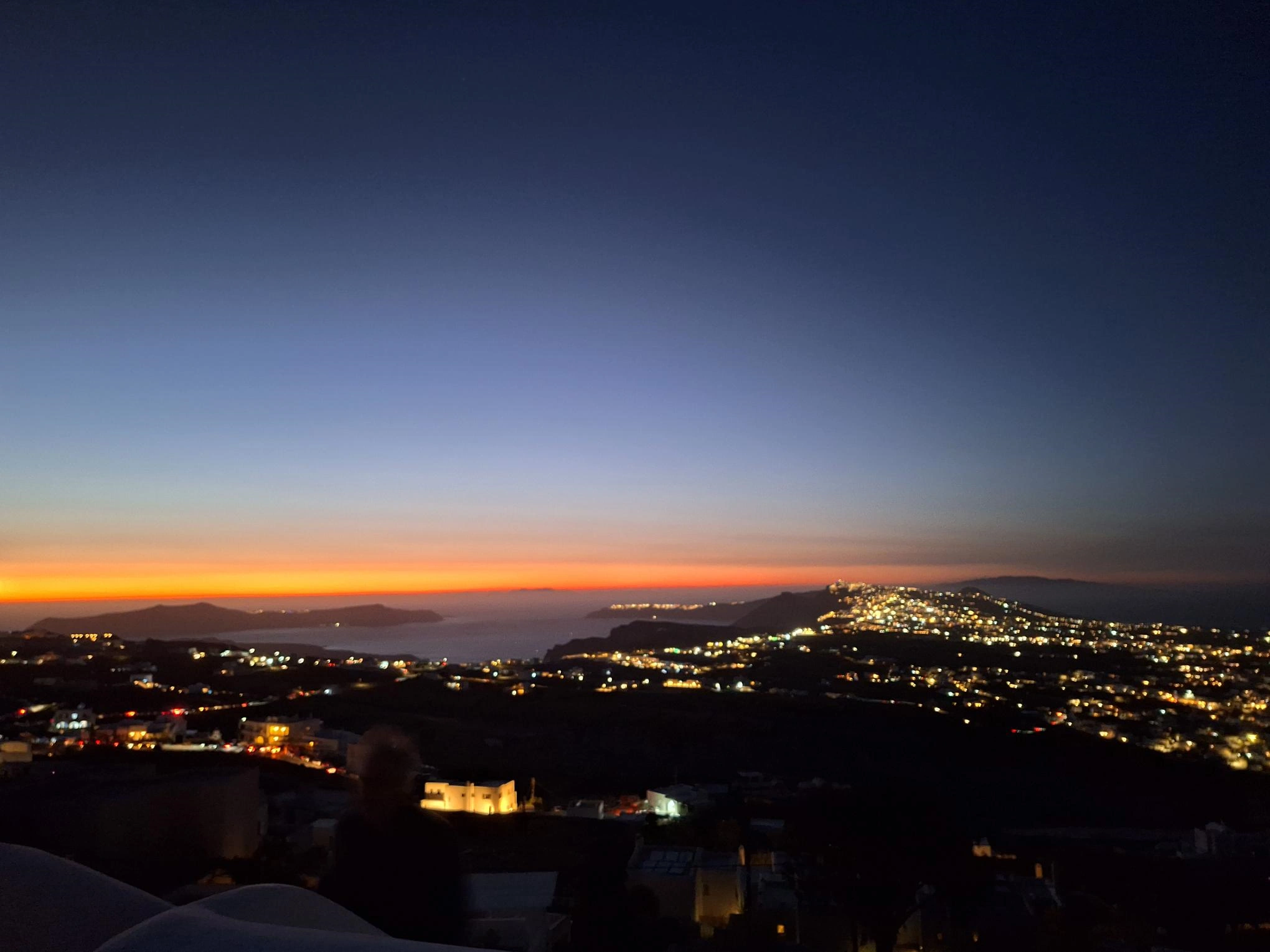
Most people who search for a quiet corner of Santorini are really asking a different question. They have seen the photographs: the white terraces stacked above the caldera, the blue domes, the sun going down behind a thousand raised phones, and somewhere underneath the planning, a small worry has formed: what if the place I have been dreaming about is already too full to feel like anything at all?
It’s a fair worry. In recent years, parts of Santorini have come to stand for exactly the kind of travel that leaves people more tired than when they arrived. But the island is not one place, and it never was. The crowds gather in two or three famous spots along the north side, and almost everywhere else, the older Santorini simply continues—quieter, slower, and far closer to what visitors are dreaming of.
The honest answer to “where do I stay to avoid the crowds” is not a hotel. It’s a mindset shift and a decision about geography. And the geography that changes the most is the one almost no one books first: the interior villages.
I.Why the crowds gather where they do
The famous congestion of Santorini is remarkably easy to predict once you understand its source: cruise passengers and day trippers arrive for a fixed window of hours and move, more or less together, toward the same caldera viewpoints. The result is that two villages absorb an enormous share of the island’s foot traffic, while the lanes a short drive inland stay almost as they have always been.
This means the overcrowding so many travellers fear is not really an innate Santorini quality. It’s where on Santorini you choose to be at the rush hour. Move the centre of your stay, and the rhythm moves with it.
Santorini is not one island. There is the fast lane — and then there’s the slow one. You choose one the moment you choose where to stay.
II.Oia, Fira, Pyrgos: three different versions of Santorini
It helps to be plain about what each place actually offers, without the usual brochure language. The differences are not subtle.
None of these is “better” in the abstract. But if the thing you are protecting is your sense of calm—the reason you booked a holiday at all—then the choice is right there.
III.What the right village for you actually changes
Staying inside a working village rather than along the viewpoint cliff alters something more fundamental than your view. It alters your pace. Mornings begin with fresh bread rather than fixed itineraries; the day opens at its own pace. Evenings on a terrace stretch out, because there’s nowhere you’re rushing to photograph.
This is the quiet truth behind the question of where to stay: people remember almost nothing of the amenities and the specifications. What stays with them is the atmosphere: the rhythm of a place, the way it changed their sense of time.
It’s also the older and more honest Santorini. The volcanic soil, the wine that comes from it, the architecture built thick against the heat, the traditions that did not arrange themselves for visitors—all of it is still here, a little deeper into the map, waiting for the travellers who think to look.
IV.An example of this approach
Historical Villa Santa Croce was not designed to compete with the cliffside hotels. It sits inside Pyrgos, in a restored historical residence, because the entire idea was to give people the slow island rather than the fast one and to let a stay feel like entering the life of a village rather than observing it from a balcony.
The house is itself a small record of why this village matters at all. Its oldest part was a medieval defence tower, built when Pyrgos held the last and strongest Venetian fortress on the island—two gun holes are still visible on the upper floor. Like the other grand houses of the settlement, it was once linked to the Kasteli, the fortified core at the top of the hill, by an underground passage that archaeologists began to uncover and never fully traced. Over the centuries the tower grew into a family residence as the Vinsanto wine trade brought prosperity, was renovated again in the neoclassical taste of the late nineteenth century, and then fell silent for some sixty years after the 1956 earthquake that reshaped so much of Santorini.
What matters for a guest is what was done with those ruins. The house was preserved rather than rebuilt—restored stone by stone under the supervision of the Greek Ministry of Culture, its collapsed ceilings rebuilt in the old way with stone, lime and volcanic pumice rather than concrete, and a fragment of the original earthquake-damaged wall left deliberately exposed. The value here is in the continuity, not novelty. Guests tend to describe their days the same way: quieter than expected, and fuller. It’s what the village does—and what a house that still remembers its original shape does, too.
A quiet signal
Santa Croce holds the Mindful Escape Tourism Recognition Sign, a distinction held by a small, carefully selected group of businesses worldwide. Mindful Escape Tourism is a philosophy built around five pillars: connection, slowing down, simplicity, silence and space, and authenticity. The Sign is not for those who merely follow these ideas but for those who, through assessment and lived commitment, embody them. For the conscious traveller, it’s a quiet but powerful signal of what awaits.
So the real answer to where to stay in Santorini without the crowds is less about finding a loophole and more about changing the question. Stop asking which famous spot is least busy. Ask instead which version of the island you actually want to wake up inside.
If the quieter one is the answer—the village, the slower mornings, the evenings that do not need an audience—then you’re in the right place. And you may find that the island you were afraid of missing was there all along, a short way inland, keeping its own time.
A soft invitation
If this quieter side of Santorini is the one you came for, Santa Croce was created around exactly that rhythm.
Discover the villa Receive Echoes from Santa CroceCommon questions about where to stay in Santorini without the crowds
What is the least crowded area to stay in Santorini?
The inner villages are consistently the quietest places to stay. Pyrgos—a former capital of Santorini and one of its oldest medieval settlements—is among the most rewarding: central enough that the whole island is within easy reach, yet far enough from the caldera trail that the pace is genuinely different. Oia and Fira absorb the majority of foot traffic because that is where the famous viewpoints are; move a short drive inland and the rhythm changes. Mornings are quieter, evenings belong to the village rather than a sunset crowd. What draws people back to Pyrgos is less a claim to unspoiled authenticity than something more specific: its labyrinthine medieval layout, its food, the fact that the archaeologist Lefteris Zorzos calls it home, and the kind of cultural life—open-air concerts, local gatherings—that grows from a place with actual roots rather than a constructed experience.
Is Pyrgos a good place to stay in Santorini?
Yes, particularly for travellers who want authenticity and calm over nightlife and caldera views. Pyrgos offers stone lanes, churches, bakeries and bell towers, with a quiet that returns the moment the day-trip buses leave. It sits in the centre of the island, so most of Santorini is within easy reach, but you return each evening to a working village rather than a crowd.
Should I stay in Oia, Fira, or somewhere quieter?
It depends on what you are protecting. Oia is spectacular but draws a standing sunset crowd every evening and is rarely restful as a base. Fira is the busy capital—convenient and energetic, but the energy does not switch off. If calm is the reason you booked the trip, a quieter inland village such as Pyrgos is the stronger choice.
How do I avoid the cruise crowds in Santorini?
Cruise passengers arrive for a fixed window of hours and move together toward the same caldera viewpoints in Oia and Fira. The simplest way to avoid them is to base yourself away from those two villages and to explore the cliff areas early in the morning or after the ships depart in the evening, when the lanes empty out.
Is Santorini still worth visiting if it’s crowded?
Yes, because the crowding is a property of a few specific places, not of the island as a whole. The older, slower Santorini continues almost everywhere else: the volcanic vineyards, the inner villages, the traditions that were never arranged for visitors. Choosing where to stay carefully lets you experience that quieter island rather than the congested postcard version.


